How-To
Inside vs outside mount blinds
5 min read
Read Compare blackout zebra blinds, room darkening roller shades and lined curtains for bedrooms and nurseries, including why light leaks at the edges and how to stop it.
For a truly dark bedroom, the best choice is usually a room darkening roller shade with a blackout fabric, mounted so it overlaps the window frame. Blackout zebra blinds suit bedrooms where you also want filtered daylight during the day, and lined curtains layered over either one reduce the remaining gaps at the edges.
Key takeaways: blackout describes the fabric, not the colour, so light-coloured blackout fabrics exist. Most light in a "blackout" bedroom comes around the edges, not through the fabric. The mount and fit matter as much as the product. Layering curtains over a shade gives the darkest result.
Blackout means the fabric itself is opaque and stops light passing through it when it is lowered. It does not mean the room will be pitch black. A blackout fabric can be white, cream or grey, so you do not need a dark colour to get a dark room. If a light colour suits your bedroom better, ask to see light-coloured blackout samples.
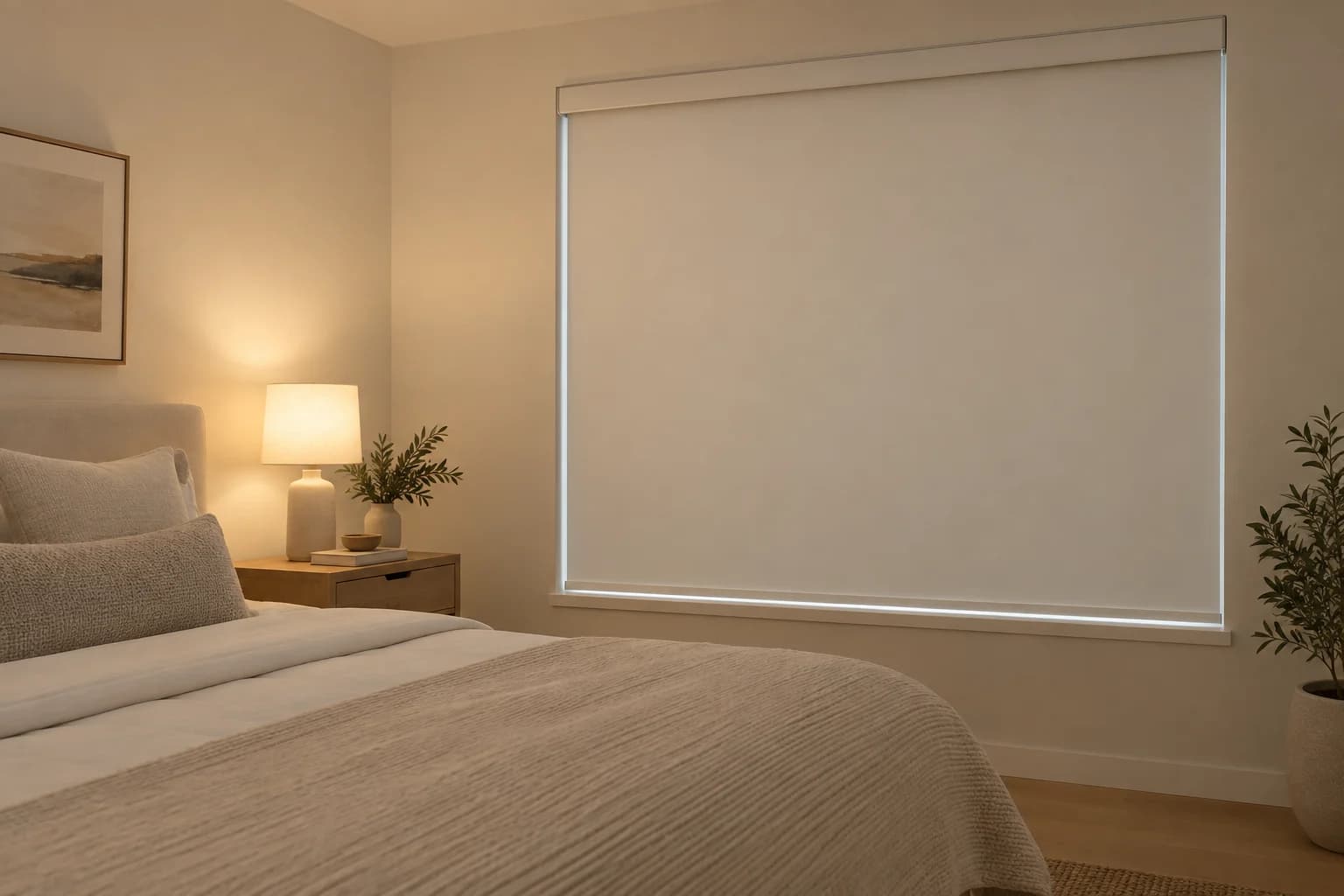
An inside-mounted shade sits within the window opening and has to be slightly narrower than it so it can move freely, so some light passes around its sides and top. An outside-mounted shade overlaps the opening and leaves smaller gaps, but some light can still reach the room around its edges. That edge light is the main reason a blackout product can disappoint, and it is why fitting advice matters as much as the fabric you choose.
Room darkening roller shades are a single continuous panel of blackout fabric. Golden Frames sells this product as room darkening roller shades; the fabric itself is blackout, so here the two terms describe the same shade. With no bands or slats, there are no gaps across the face of the shade, which makes it the darkest single option in our range for daytime sleep.
Choose a roller shade when the priority is darkness: shift workers sleeping during the day, nurseries at nap time, east-facing bedrooms that get early sun, and home theatres. The trade-off is that a roller shade is either up or down. To let in softer light you raise it. For a nursery, ask about cordless or motorized operation; Canadian rules (SOR/2019-97 (opens in a new tab)) limit reachable cords on window coverings because of the strangulation risk to young children.
Blackout zebra blinds use two layers of fabric with alternating sheer and solid bands, where the solid bands are blackout fabric. Shift the layers so the solid bands cover the sheer bands and the room darkens; line the sheer bands up with each other and daylight comes through them while the blind stays down.
Zebra blinds are a good fit when a bedroom is also used during the day, such as a guest room, a teenager's room or a bedroom with a desk. They are flexible, but because two layers meet, a closed zebra blind lets a little more light through than a single roller panel.
Lined curtains and drapery can be made with blackout lining. On their own they darken a room well when the fabric extends past both sides of the window and above the frame. Their bigger strength is layering: a blackout curtain drawn over a roller shade or zebra blind covers the edge gaps the shade leaves behind.
Curtains also soften a bedroom and add warmth to the look of the room. If you already have curtain rods you want to keep, bring that up at your consultation so the new treatment can work with them.
Most edge light can be reduced with the right mount (see inside vs outside mount blinds). An inside mount sits within the window frame and looks tidy, but it leaves a small gap on each side. An outside mount covers the frame and overlaps the opening, which usually blocks more light. If your window frame is shallow, an outside mount may be the only option for a blackout shade.
Other ways to darken a bedroom further are to choose a deeper overlap with an outside mount, to add curtains that extend beyond the window, or to pair a blackout zebra blind with a curtain. We measure the window, check the frame depth and look at what is around it, such as handles and trim, before recommending a mount.
In general use, blackout describes a fabric that stops light passing through it, while room darkening describes the effect in the room, which also depends on the fit. At Golden Frames, room darkening roller shades use blackout fabric, so the fabric blocks light and the mount decides how much gets in around the edges.
Choose a room darkening roller shade if darkness is your first priority. Choose a blackout zebra blind if you want darkness at night and filtered light during the day without raising the blind. Add blackout curtains if you need the darkest possible room or want a softer, layered look. For a quick overview of every product name, see our window coverings guide.
Are blackout blinds 100% dark?
No product makes a room completely dark on its own, because light can enter around the edges. A well-fitted blackout roller shade with an outside mount, layered with curtains, gives the darkest result.
Do blackout blinds have to be a dark colour?
No. Blackout refers to how opaque the fabric is. Light colours such as white, ivory and grey are available in blackout fabrics.
Are blackout zebra blinds as dark as blackout roller shades?
A closed blackout zebra blind darkens a room well, but a single roller panel has no seams across its face, so it typically blocks a little more light. The zebra blind gives you more daytime flexibility in exchange.
Golden Frames brings blackout and light-filtering samples to your home so you can compare them in the actual bedroom. Book a free consultation in St. Thomas, London or any of our service areas. The room photograph with this guide is an illustrative design concept. Written by Golden Frames, a family-owned window coverings business based in St. Thomas, Ontario.
Ready to transform your space?
Bring these ideas home.
Custom blinds, shades and curtains — measured, crafted and installed across St. Thomas, London and Southwestern Ontario.